Number sense is the part of first-grade math that helps everything else make sense. A child with strong number sense does more than recite numbers: they can build a quantity, break it into parts, compare it with another number, and notice how a pattern changes. These seven free Grade 1 worksheets follow that journey from visible objects to written calculations.
This collection takes a different approach from a mixed review packet. Each page acts as one step in a concrete-to-symbolic learning path. Children first count pictures and read base-ten blocks. They then explore ways to make 10, compare values, combine groups, solve subtraction facts, and complete number sequences. The clean layouts keep the task obvious, while the individual PNG downloads make it easy to choose and print one useful page at a time.
Build Numbers With Tens and Ones and Make 10
Start by helping children see how numbers are composed. Base-ten blocks show that two-digit numbers contain groups of ten and individual ones, while ten-frames make the missing partner in a number bond visible. Click either button to download the full-quality PNG directly.
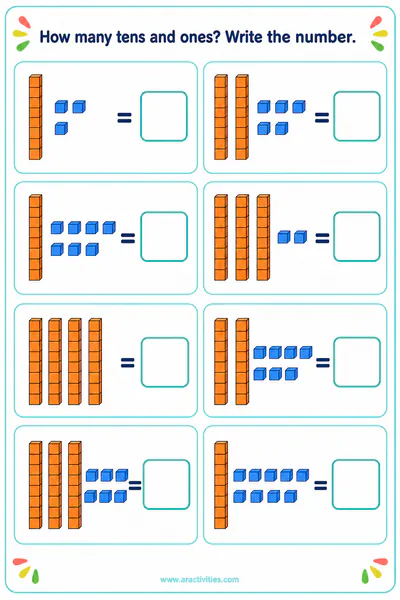
1. Tens and Ones
Read base-ten rods and unit cubes, then write each two-digit number. Ask the learner to say “three tens and two ones” before writing 32.
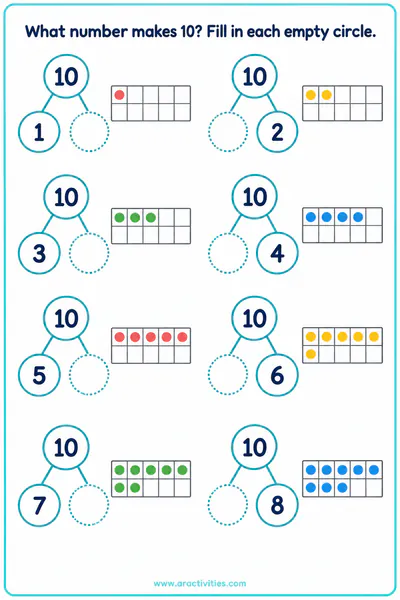
2. What Makes 10?
Use each ten-frame to find the missing partner. The pictures help children see that the empty spaces and filled spaces always total 10.
After the first pair: ask the learner to build one two-digit number with household objects grouped in tens, then name two different pairs that make 10. This connects the worksheet pictures to quantities the child can touch and rearrange.
Compare Numbers and Practise Subtraction
This pair moves into relationships and operations. Comparison asks which value is greater, smaller or equal; subtraction asks how much remains after a part is removed. Model both ideas with counters or a number line before independent practice.
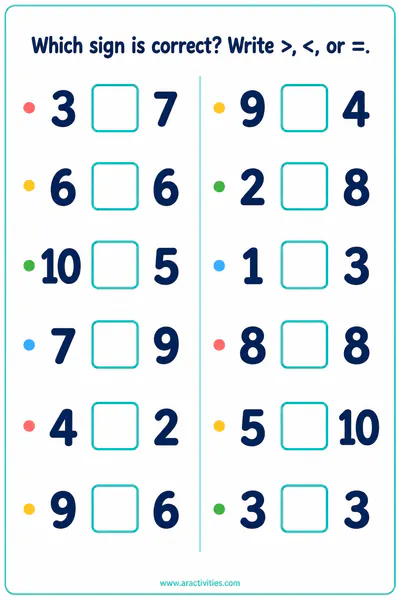
3. Compare Numbers
Write >, < or = between 12 number pairs. Have children read each statement aloud so the symbol is connected to mathematical language.
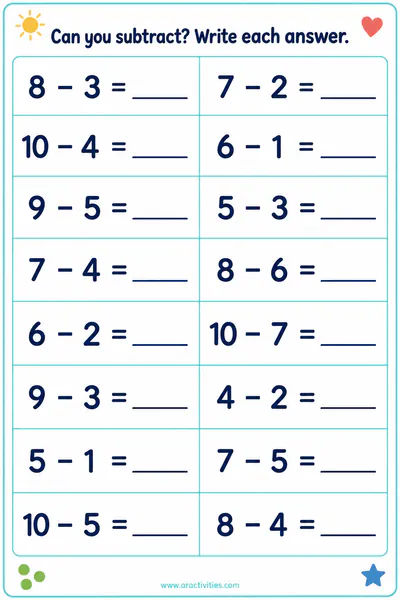
4. Subtraction Within 10
Solve 16 focused subtraction equations. Children who need support can draw the starting amount and cross out the part being removed.
After the second pair: choose one comparison and ask the child to prove it by drawing both quantities. Then turn a subtraction equation into a short story, such as “Eight birds were sitting together and three flew away.”
Count Carefully and Move Into Picture Addition
These two pages connect accurate counting with addition. The first checks whether the learner counts every object once and matches the total to a numeral. The second keeps the objects visible while introducing the mathematical action of combining two groups.
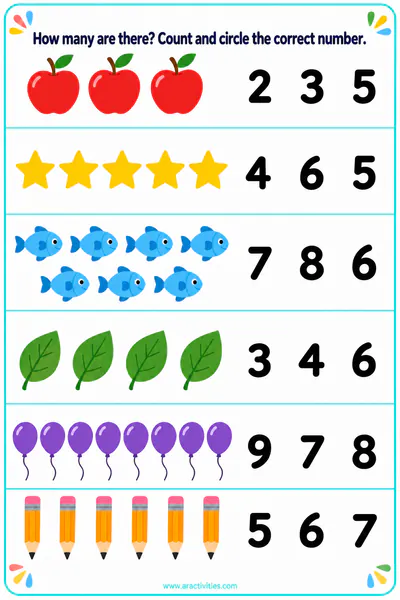
5. Count and Choose
Count six illustrated groups and circle the matching numeral. This is a useful check for one-to-one counting and accurate numeral recognition.
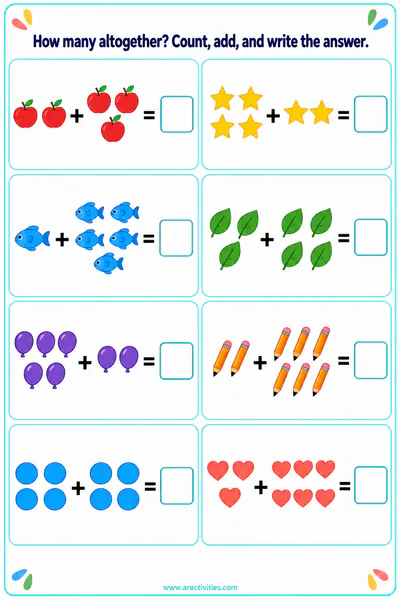
6. Count, Add and Write
Combine two pictured groups and write each total. The page bridges counting real quantities and understanding the plus and equals signs.
After the third pair: let the child invent a picture addition problem using toys, buttons or drawn shapes. Ask them to show the two parts first, combine the groups, and finally write the matching equation.
Finish With Missing Number Patterns
The final worksheet stands alone because it brings several number relationships together. Children must notice whether each sequence moves forward, backward or by a larger step before they can identify the missing value.
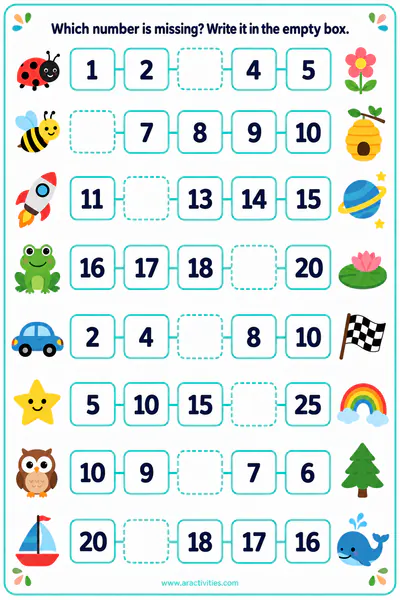
7. Find the Missing Number
Complete forward, backward and skip-counting patterns to 25. Ask children to describe the step—plus one, minus one, plus two or plus five—before writing.
After the final page: create a new five-number pattern aloud and pause before one number. Let the learner identify the rule, supply the missing value and then create a pattern for you to solve.
Use the Pages as a Learning Path
The pages do not have to be completed in their file-number order. Choose the starting point from what the child can already do:
- Begin with Count and Choose if the learner skips objects, counts one item twice or confuses the final quantity with the last object touched.
- Move to Tens and Ones when single-digit counting is secure and the child is ready to see why the 2 in 24 represents two tens.
- Use What Makes 10? to develop combinations that later make mental addition and subtraction faster.
- Compare Numbers after children can build both values with objects or locate them on a number line.
- Try Picture Addition before expecting fluent symbolic addition. The objects make the action of combining visible.
- Use Subtraction Within 10 once the child can act out taking away and understands that the amount becomes smaller.
- Finish with Missing Number Patterns to apply number order flexibly in forward, backward and skip-counting sequences.
Turn One Worksheet Into a Short Math Conversation
A printable becomes more valuable when a child explains a strategy. After completing several questions, choose one and ask, “How did you know?” A learner might explain that eight balloons match the numeral 8, that two empty spaces complete a ten-frame, or that 20, 19, 18 is counting backward by one. Those explanations reveal more than a page of unchecked answers.
If an answer is incorrect, avoid giving the rule immediately. Rebuild the quantity, cover part of the ten-frame, draw the subtraction, or place both comparison numbers on a number line. When the child corrects the model, return to just one similar question on the worksheet.
Easy Download and Printing Tips
- Use the button under a preview to download that individual high-resolution PNG.
- Open the saved image and select Fit to page if your printer adds margins.
- Print in colour for the clearest visual grouping, or use a high-quality grayscale setting when needed.
- Place a printed page in a reusable sleeve and use a dry-erase marker for repeated practice.
- Assign only the section the child needs. A short, careful practice session is more useful than rushing through every page.
Frequently Asked Questions
Are these Grade 1 worksheets really free?
Yes. All seven are free PNG downloads with no account or email sign-up required.
What skills do they cover?
They cover counting, numeral recognition, tens and ones, making 10, comparing numbers, picture addition, subtraction within 10, and missing-number patterns.
Are they suitable for independent work?
The uncluttered layouts support independent practice, but introduce or model an unfamiliar skill first. A worksheet is practice rather than the complete lesson.
Can teachers and homeschoolers print them?
Yes. Download the individual PNG files and print the pages needed for your learners. The website's terms still apply to redistribution or resale.
Build number sense one clear step at a time
Choose one page, model the idea with objects or a drawing, and let the learner explain a few answers. For another set covering related first-grade skills, explore the original eight-page collection.
See 8 More Grade 1 Worksheets → Play Free Math Games →