A useful first-grade worksheet should reveal what a child understands—not simply keep a pencil moving. Can the learner count each object once? Do they see that 7 and 3 make 10? Can they explain why 4 is less than 7? The eight free Grade 1 math worksheets below target one clear skill at a time, making them easier to teach, complete and review.
The collection moves from visual counting into number order, addition, subtraction and relationships between numbers. It finishes by combining shape recognition with counting. Parents, homeschoolers and teachers can download each activity separately, so there is no need to print a large packet when a child only needs one kind of practice.
Download the Free Grade 1 Math Worksheets
Choose the page that matches the learner's current goal. Each preview shows the complete activity, and every button downloads the printable worksheet directly.
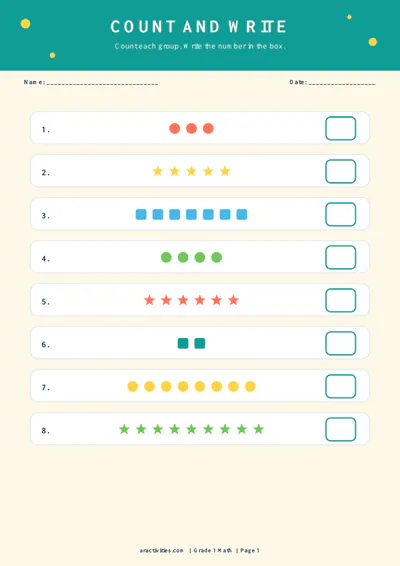
1. Count and Write
Count eight groups of dots, stars and squares, then write each total. Encourage children to touch or mark every object once.
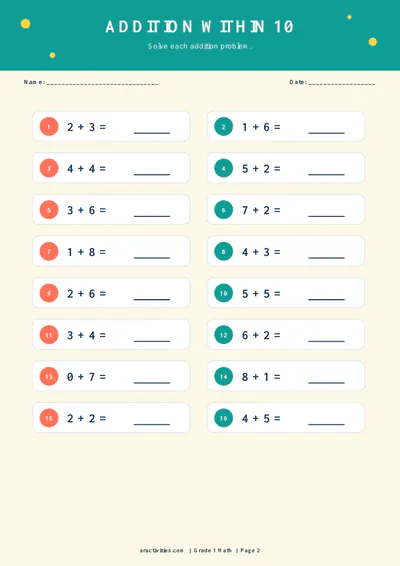
2. Addition Within 10
Solve 16 addition equations with sums no greater than 10. Children can draw dots or use counters when a fact is not yet automatic.
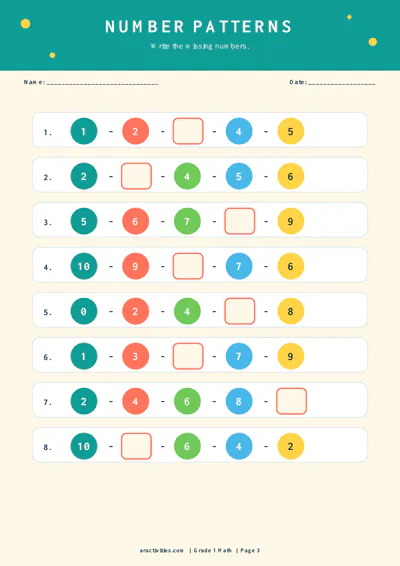
3. Number Patterns
Find the missing number in forward, backward and count-by-two sequences. Ask the learner to state the rule before filling the box.
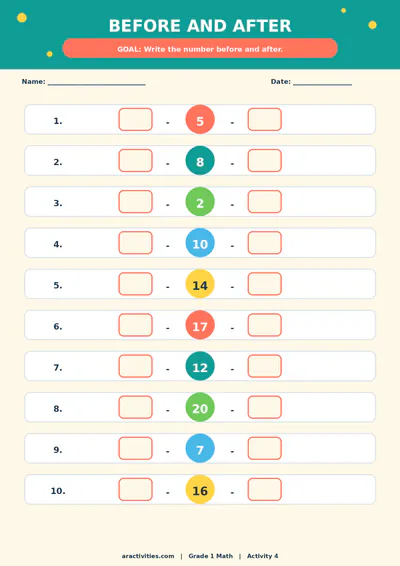
4. Before and After
Write the number immediately before and after ten values up to 20. A small number line can support children who still recount from one.
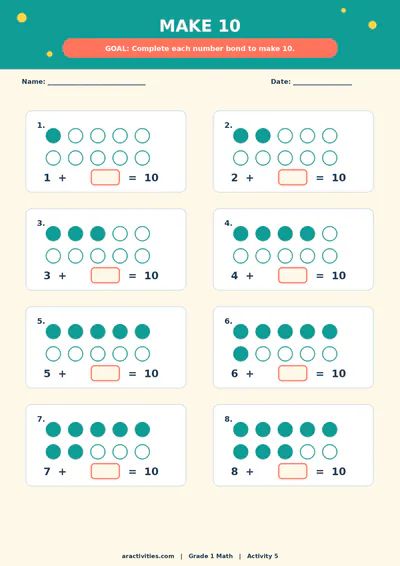
5. Number Bonds to 10
Complete eight visual number bonds. The filled and empty circles help learners see the missing partner that combines with each number to make 10.
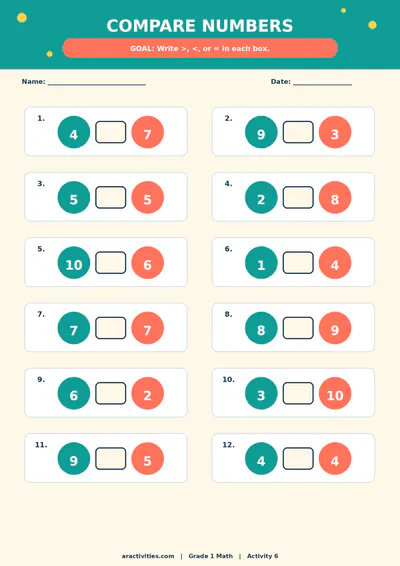
6. Compare Numbers
Choose >, < or = for 12 number pairs within 10. Ask children to read each completed statement aloud in words.
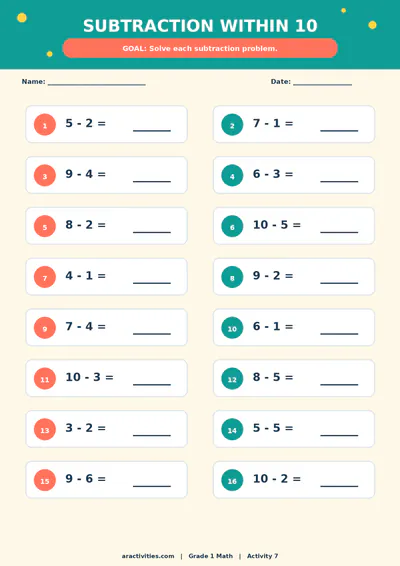
7. Subtraction Within 10
Solve 16 subtraction equations. Learners can cross out drawn dots or move counters away before recording the difference.
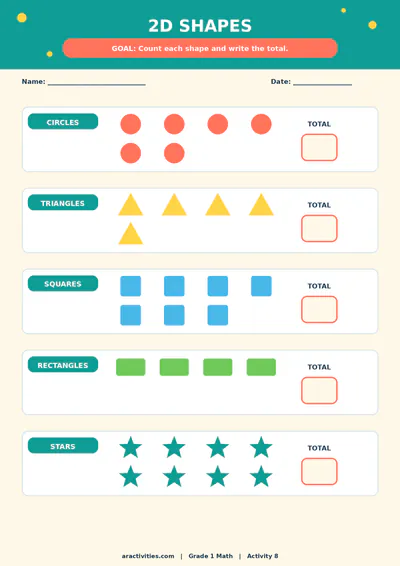
8. Count 2D Shapes
Count circles, triangles, squares, rectangles and stars. This page combines shape vocabulary with careful visual scanning and accurate counting.
How to Choose the Right Worksheet
Start from evidence rather than grade labels alone. Watch the learner complete two examples and notice the strategy:
- If objects are skipped or counted twice, begin with Count and Write.
- If the child can count accurately but hesitates about order, use Before and After or Number Patterns.
- If addition is still counted one by one, use Number Bonds to 10 with counters before the equation page.
- If symbols are confusing, model comparison with two groups before using Compare Numbers.
- If subtraction answers are guessed, act out “take away” situations before independent practice.
A Five-Day Grade 1 Math Review Plan
Use Count and Write, then ask the learner to build two selected quantities with counters.
Choose either Before and After or Number Patterns according to the child's current need.
Complete several number bonds with objects before recording the missing partners.
Select addition or subtraction—not necessarily both—and focus on explaining strategies.
Compare numbers or count shapes, then revisit only one error pattern from the week.
Differentiate Without Creating Another Worksheet
The same printable can work at several levels when the support changes:
- More support: provide counters, a ten frame or a number line and complete the first example together.
- Standard practice: let the child work independently, then explain two selected answers.
- More challenge: ask the learner to create a similar question, prove an answer in another way or write a related story problem.
- Shorter workload: fold the page or circle only four to eight questions. Completing fewer questions thoughtfully can provide better evidence than rushing through all of them.
Review Mistakes for Learning, Not Just a Score
Instead of marking every incorrect answer and moving on, group errors by cause. A counting error needs a different response from a reversed comparison sign or an unknown addition fact. Ask, “Show me how you worked it out.” The explanation often reveals whether the learner needs a concrete model, vocabulary clarification, more fluent counting or simply a reminder to slow down.
Frequently Asked Questions
Are these Grade 1 math worksheets free?
Yes. All eight activities are free downloads, and no account or email sign-up is required.
What skills are included?
The collection covers counting and number writing, addition and subtraction within 10, number sequences, numbers before and after to 20, number bonds to 10, comparison symbols and counting 2D shapes.
What ages are the worksheets for?
They are designed mainly for ages 5–7. A younger learner may use the visual counting pages with support, while a confident first grader may explain strategies or create extension questions.
Should my child complete every page?
No. Choose the worksheet that matches the current learning goal. These pages are individual practice tools rather than a required packet or complete curriculum.
Choose one useful skill for today
Download the page that matches the learner's current need, model one example and finish by discussing the strategy—not only the score.
Explore free interactive math games →