Children often first know Prophet Muhammad ﷺ through love: hearing salawat, listening to a parent tell a seerah story or learning that he was gentle, honest and deeply concerned for others. Mawlid al-Nabawi can offer a natural moment to deepen that connection—not by giving children a long list of dates, but by helping them discover who he was and why Muslims try to follow his example.
This free collection includes seven printable PNG coloring pages built around Arabic calligraphy: Muhammad, Al-Mustafa, Al-Amin, As-Sadiq Al-Amin, Ibn Abdullah, Abu al-Qasim and Abu az-Zahra. Download each page directly below, then use the accompanying prompt to turn coloring time into a warm, age-appropriate conversation.
What Is Mawlid al-Nabawi?
Mawlid al-Nabawi (المولد النبوي) means “the birth of the Prophet.” It is associated with Rabi al-Awwal, the month in which Prophet Muhammad ﷺ was born. Muslim communities approach the occasion in different ways. Many gather for seerah, Quran recitation, salawat, charity and family learning; others choose not to mark it as a special celebration. Families can follow their own trusted scholarly guidance while still using this moment—or any time of year—to help children learn about the Messenger of Allah.
Introducing Prophet Muhammad ﷺ to Children
Prophet Muhammad ﷺ was born in Makkah to Abdullah and Aminah and belonged to the Quraysh. His father died before he was born, and his mother died while he was still young. He grew up knowing loss, yet became known for care, patience and mercy toward others.
Before revelation, the people of Makkah knew him as Al-Amin, the trustworthy, and remembered his truthfulness. At the age of forty, he received the first revelation through Angel Jibril. Over the following years, he called people to worship Allah alone, care for the vulnerable, speak truthfully, fulfill trusts and live with justice and compassion.
Download 7 Free Mawlid Coloring Pages
Select any button to download the full-resolution PNG directly. No account or email address is required. Each card also includes one small discussion idea.
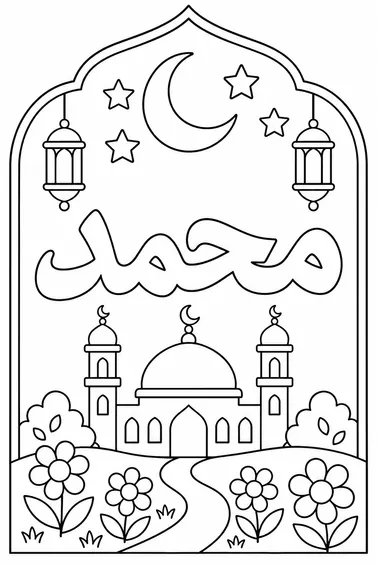
Muhammad ﷺ
مُحَمَّدMuhammad means “the often praised.” Ask: What quality of the Prophet ﷺ do you admire most?
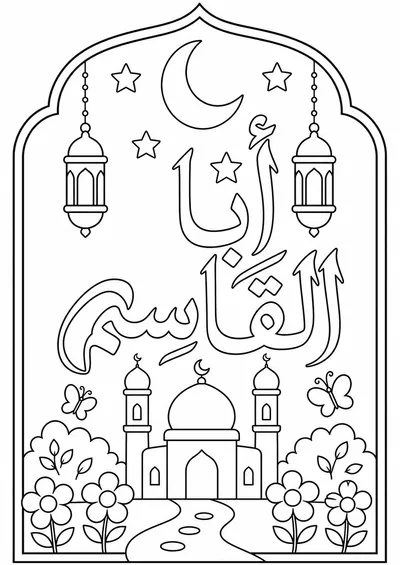
Abu al-Qasim
أَبُو الْقَاسِمAbu al-Qasim was the Prophet's well-known kunya, connected to his son Al-Qasim. Ask: What can names teach us about a person's family?
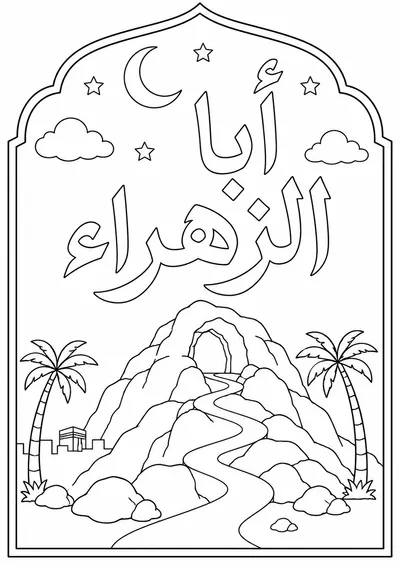
Abu az-Zahra
أَبُو الزَّهْرَاءThis affectionate description means “father of Az-Zahra,” referring to Fatimah. Ask: How can we show love and gentleness within our family?
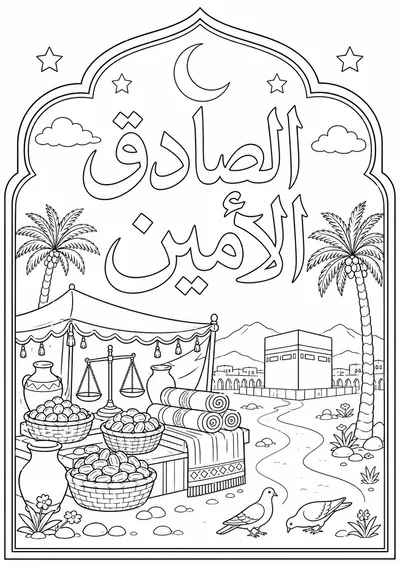
As-Sadiq Al-Amin
الصَّادِقُ الْأَمِينThe truthful and trustworthy. Ask: What does a trustworthy person do when someone gives them something to protect?
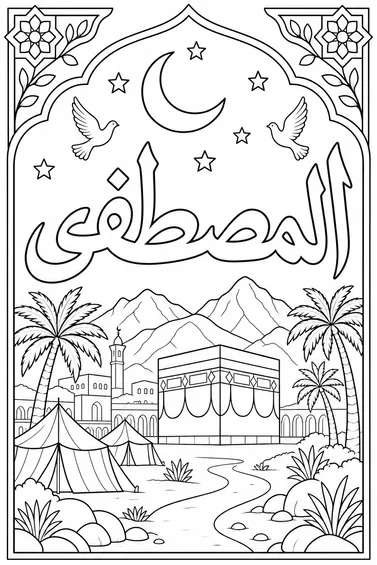
Al-Mustafa
الْمُصْطَفَىAl-Mustafa means “the chosen.” Ask: What message did Allah choose Prophet Muhammad ﷺ to share?
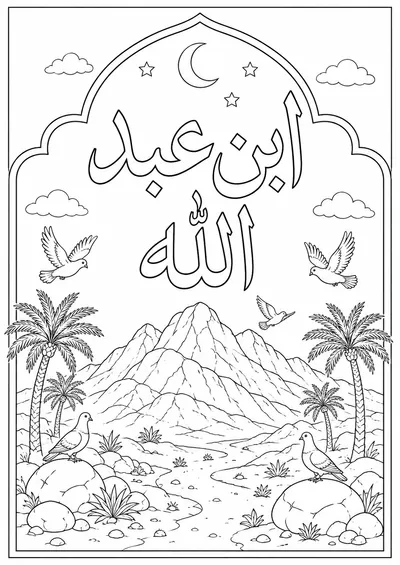
Ibn Abdullah
ابْنُ عَبْدِ اللَّه“Son of Abdullah” introduces the Prophet's family background. Ask: Who cared for Muhammad ﷺ as he grew up?
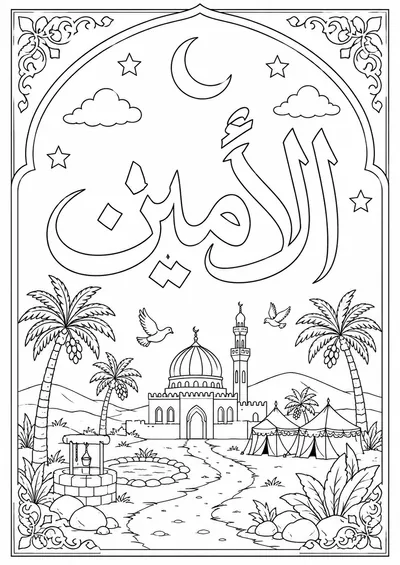
Al-Amin
الْأَمِينAl-Amin means “the trustworthy.” Ask: What is one promise or responsibility you can take good care of today?
Seven Character Lessons Children Can Carry Forward
The pages become more meaningful when each title leads to one action. Invite children to choose—not merely name—a quality to practise:
- Truthfulness: tell the truth even when admitting a mistake feels difficult.
- Trustworthiness: return borrowed belongings and keep appropriate promises.
- Mercy: respond gently to a younger child, an elderly person or an animal.
- Patience: pause before reacting when frustrated.
- Generosity: share time, food or help without expecting praise.
- Good speech: choose words that are honest and kind.
- Love of Allah: follow the Messenger by trying to do what pleases Allah.
A Simple 30-Minute Mawlid or Seerah Lesson
- Begin with salawat: explain simply that Muslims ask Allah to bless and grant peace to Prophet Muhammad ﷺ.
- Tell one short story: choose an age-appropriate seerah moment that demonstrates honesty, mercy or patience.
- Choose one title: read the Arabic calligraphy and explain its meaning in one sentence.
- Color and converse: use the prompt on the matching card without turning the activity into a test.
- End with action: let each child name one Prophetic quality they will practise.
Adapt the Printables by Age
Color the large calligraphy, repeat one name and learn one simple quality such as kind, truthful or trustworthy.
Copy the Arabic title or its English meaning and give one everyday example of the quality.
Connect the title to a seerah story, write a short reflection and set one character goal for the week.
Printing and Use
Download the PNG, open it in an image viewer and print in portrait orientation. Choose Fit to page or Scale to fit on A4 or US Letter paper. Standard paper works well for crayons and colored pencils; heavier paper is useful for markers. Parents, homeschoolers, teachers and mosque educators may print copies for their own children or students. Please do not resell or redistribute the original digital files.
Frequently Asked Questions
Are all seven Mawlid coloring pages free?
Yes. Every page is a free full-resolution PNG download. No account or email sign-up is required.
Do these pages depict Prophet Muhammad ﷺ?
No. They feature Arabic calligraphy and decorative scenes such as mosques, mountains, palms, stars and the Kaaba.
Can I use them if my family does not celebrate Mawlid?
Yes. The pages also work as general seerah, Arabic calligraphy and Islamic character activities at any time of year. Families can use them in a way consistent with their own trusted guidance.
What is the best page to begin with?
Begin with Muhammad for introducing his name, or Al-Amin and As-Sadiq Al-Amin for a practical lesson about honesty and trustworthiness.
Continue learning about the Prophet ﷺ
Pair a coloring page with a short seerah story, a family conversation and one character action your child can practise today.
Read the character-building guide →