Children rarely learn good manners from a definition alone. They learn by watching someone welcome a neighbour, waiting while a younger learner forms a letter, preparing carefully for prayer or sitting beside a parent with the Quran. A picture can slow that moment down long enough for a child to notice what respectful, caring behaviour looks like.
This collection offers ten free Islamic good manners coloring pages for children. The scenes include wudu, mosque visits, Arabic and Quran learning, Ramadan preparation, family moon-sighting, storytime and kindness at a neighbour's door. Each full-resolution PNG can be downloaded directly below without creating an account.
What Are Adab and Akhlaq for Children?
Adab often refers to respectful conduct and the right way to behave in a situation. Akhlaq refers more broadly to character and moral qualities. For a young child, both ideas become understandable through concrete actions: speaking gently, keeping clean, listening carefully, helping at home, respecting learning, welcoming others and remembering Allah in daily life.
1. Respect for the Mosque and Careful Wudu
The mosque pair begins with wonder and preparation. Let the pictures invite curiosity before giving instructions. Ask what makes the building feel special, what the child may do after entering and why Muslims prepare for salah with wudu.
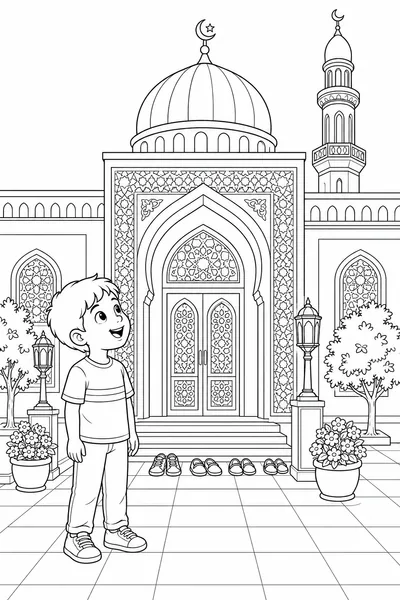
Boy Marveling at the Mosque
Notice the mosque entrance, shoes and welcoming surroundings. Ask: How can we enter and behave respectfully?
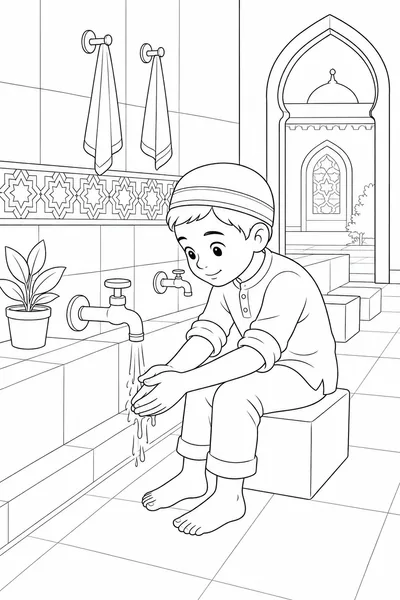
Wudu Hand-Washing at the Mosque
Talk about preparing for prayer, washing carefully and using water without waste.
After coloring: practise one mosque routine together—placing shoes neatly, lowering voices or leaving a shared space tidy. During wudu, focus on one manageable habit such as completing each step calmly and turning off the tap.
2. Gentle Guidance and Respect for Learning
Learning manners are easy to overlook. A patient adult, an encouraging voice and a child who feels safe to make mistakes are part of Islamic character education too. These pages can support a conversation about asking for help, listening without interrupting and treating books and learning materials with care.
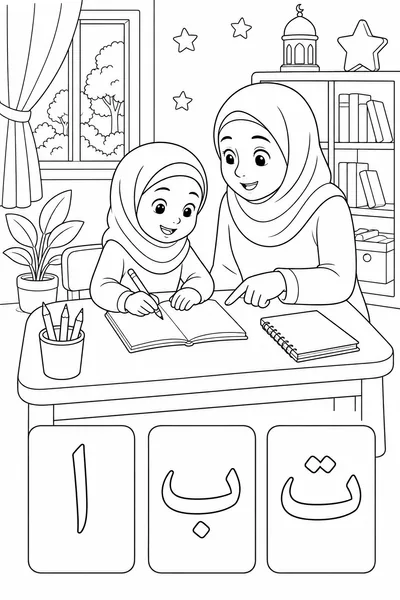
Learning Arabic With Gentle Guidance
Use Alif, Baa and Taa to discuss patience, encouragement and how a learner can respond when work feels difficult.
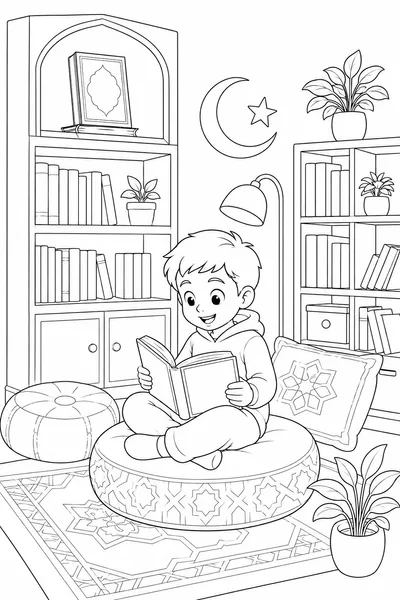
Cozy Islamic Storytime Corner
Ask how we show care for a book, listen to a story and share a peaceful reading space.
Build the habit: create a small learning routine with a clear beginning and ending. Put materials out together, practise for ten focused minutes, praise sincere effort and return everything to its place.
3. Family Quran Time With Patience and Respect
These two scenes show a parent and child learning side by side. They can represent recitation, listening, following Arabic text or learning a short surah. Keep the discussion warm and specific: respectful Quran learning includes clean hands, careful handling, attentive listening and patience with correction.
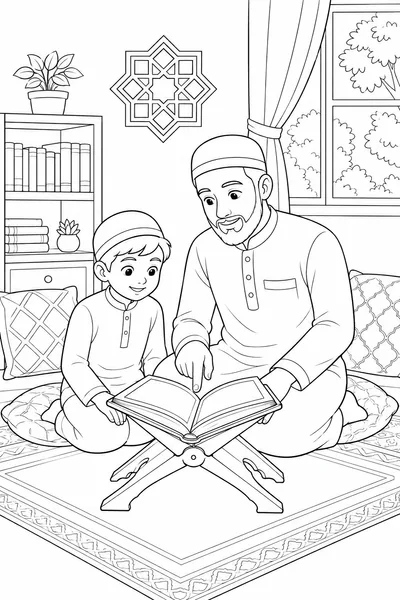
Father and Son Learn the Quran
Talk about listening carefully, taking turns and encouraging someone who is still learning.
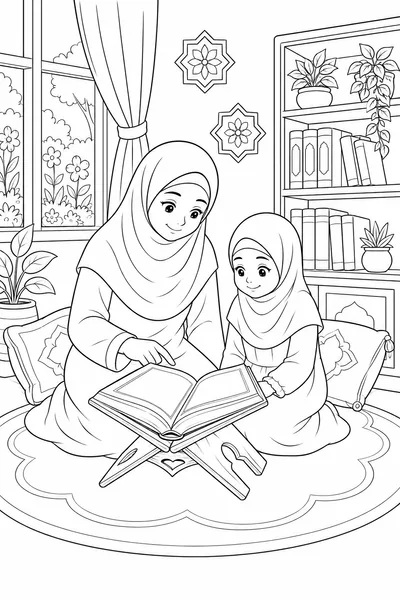
Mother and Daughter Learn the Quran
Ask what helps Quran time feel calm, respectful and encouraging in a busy family routine.
Respectful use: because these pictures show the Quran, use and display them thoughtfully. Keep the pages in a clean place, and follow the guidance of your family, school or trusted local scholar when a finished page is no longer needed.
4. Cooperation, Gratitude and Ramadan Joy
Ramadan memories are often made through shared preparation. Children may help hang decorations, watch for the crescent, set the table or welcome relatives. The goal is not a perfect display; it is learning to contribute, wait, notice and feel grateful together.
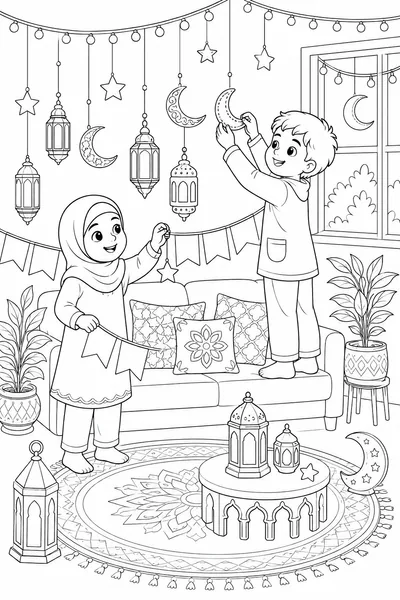
Children Decorating for Ramadan
Discuss safe teamwork, sharing materials and helping without arguing over every choice.
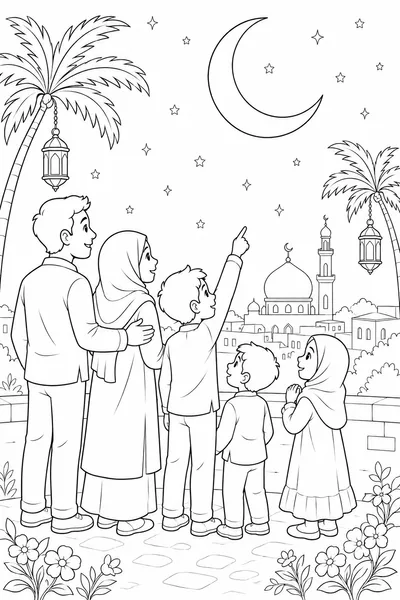
Family Watches the Ramadan Crescent
Invite children to notice the sky, practise patience and name something they are grateful for as Ramadan approaches.
Make it practical: give each child one real contribution that fits their age—place napkins, make a welcome card, tidy the coloring supplies or help a younger sibling. Specific responsibility makes cooperation easier to understand.
5. Kindness to Neighbours and Walking Together
The final pair moves good manners beyond words. One scene shows children bringing a covered dish to an older neighbour; the other shows siblings walking through a garden toward the mosque. Both can begin a conversation about noticing other people's needs, greeting warmly, including younger children and making community spaces feel welcoming.
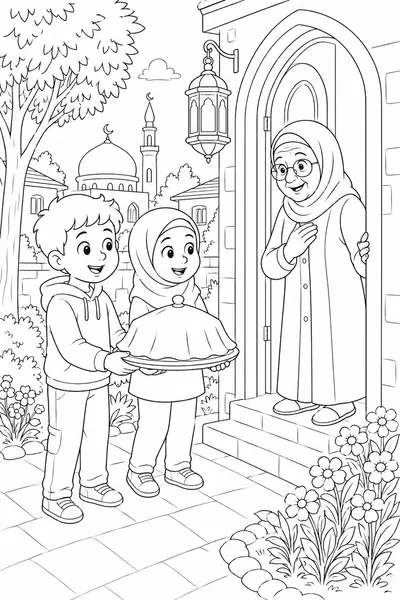
Ramadan Kindness at the Doorstep
Ask how the neighbour might feel and what children can share besides food: time, a greeting, help or a handmade card.
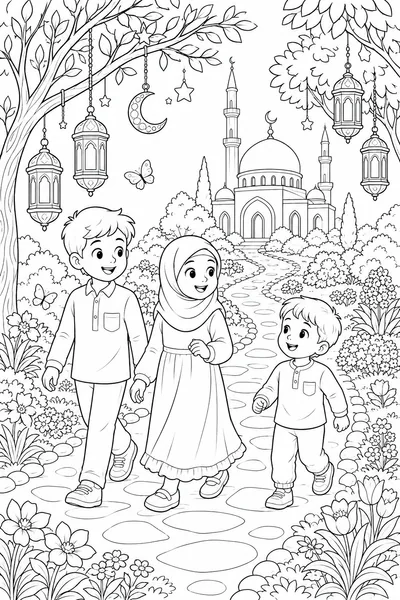
Garden Walk Toward the Mosque
Talk about staying together, looking after younger companions and greeting people along the way.
Choose one action: before ending the activity, let the child choose one small kindness they can complete today. Keep it observable and realistic: greet someone, carry an item, share a snack or invite a sibling to join.
How to Teach Manners Without Turning Coloring Into a Test
Good manners grow through modelling, repetition and repair. Avoid asking a stream of questions with one expected answer. Instead, notice one detail, share a family example and invite the child to suggest an action. If a child remembers a time they did not behave well, focus on what they can try next rather than using the picture to shame them.
- Describe before judging: “The children are carrying a dish together.”
- Name the value: “That can be a way of showing generosity and care.”
- Connect to real life: “Who might appreciate a kind visit from us?”
- Practise one step: choose a small action the child can complete independently.
- Notice progress: praise the specific choice rather than giving a general “good child” label.
Adapt the Coloring Activity by Age
Name the people and actions, identify one feeling and repeat a short phrase such as “We use kind hands” or “We listen gently.”
Add a speech bubble with a greeting, thank-you or encouraging sentence, then choose one matching action.
Write a short reflection about the value in the scene, a challenge children may face and a respectful response.
Printing and Classroom Use
Each resource downloads as a full-resolution PNG. Open the image, choose portrait orientation and select Fit to page or Scale to fit. The pages work on A4 and US Letter paper. Standard paper is suitable for crayons and colored pencils; heavier paper is helpful for markers. Parents, homeschoolers, teachers and mosque educators may print copies for their own children or students. Please do not resell or redistribute the original digital files.
Frequently Asked Questions
Are all ten Islamic good manners coloring pages free?
Yes. Every page is a free full-resolution PNG download. No account or email address is required.
What ages are these pages designed for?
They are most suitable for ages 4–10. Adjust the conversation rather than the picture: younger children can name actions and feelings, while older children can write reflections and goals.
Do I need to use all ten pages as one lesson?
No. Choose the pair that matches a current family or classroom need. One picture, one conversation and one action are enough for a meaningful short lesson.
Can I use them outside Ramadan?
Yes. Several pictures have Ramadan details, but the values—kindness, patience, cooperation, gratitude and care for others—are useful throughout the year.
Can I print copies for my class or mosque group?
Yes. You may print copies for your own students or children. Please do not sell or redistribute the digital PNG files.
Explore more free Islamic printables
Continue with mosque, prayer, Quran, Ramadan, Mawlid and Names of Allah coloring pages in the free printable library.
Browse Islamic Coloring Pages →