When a child colors a lion beside أَسَد, the letter أ is no longer an isolated symbol to memorize. It has a sound, a word and a picture attached to it. That meaningful connection gives young learners more ways to recognize and remember both the Arabic letter and the new animal name.
These free Arabic alphabet coloring pages turn six letter-and-word pairs into relaxed, screen-free practice. They are simple enough for home, preschool, kindergarten, an Arabic classroom or a weekend school—and flexible enough to use for a quick letter-of-the-week activity, literacy center or early-finisher task.
Why Animals and Coloring Make Arabic Easier to Remember
Young learners remember new information more easily when it is connected to something familiar. An animal picture gives a concrete meaning to an unfamiliar Arabic word, while the printed label shows what that word looks like. The child can move back and forth between letter, sound, word and image instead of trying to learn each one separately.
Coloring also gives children time to look closely. That sustained attention can help them notice the shape and dots of the target letter. The hand movements used to color inside larger spaces strengthen pencil control, too. Coloring alone, however, does not teach pronunciation or guarantee recall. A short say-point-find routine makes the page far more useful as a language activity.
1. Alif With Lion and Baa With Duck
Begin with two clear, memorable words. أَسَد (asad, lion) begins with أ, and بَطَّة (baṭṭah, duck) begins with ب. Say each word slowly, emphasize the first sound and let the child point to the matching letter before choosing colors.
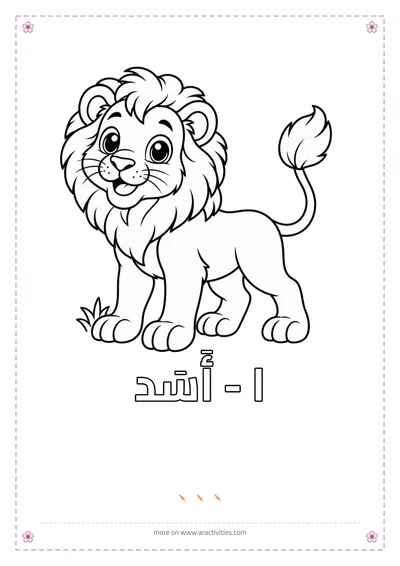
Alif — Lion
Trace the outlined Alif with a finger, say “asad,” then find Alif again in the animal name.
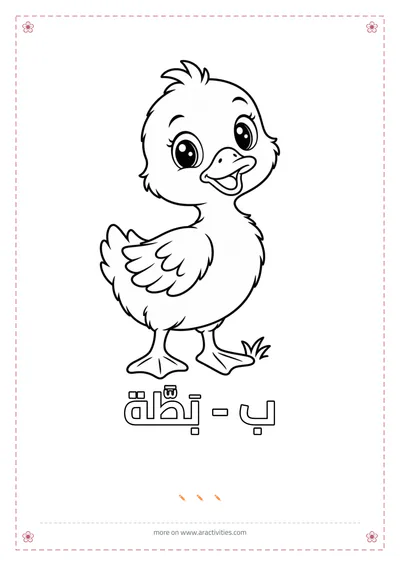
Baa — Duck
Notice the single dot below Baa, repeat “baṭṭah,” and point to the first letter in the word.
After coloring: place both pages side by side. Say either “asad” or “baṭṭah” without pointing, and ask the child to touch the correct animal, then its first letter. Switch roles and let the child quiz you.
2. Thaa With Fox and Haa With Horse
This pair makes dot patterns especially useful. ثَعْلَب (thaʿlab, fox) begins with the three-dotted ث. حِصَان (ḥiṣān, horse) begins with ح, which has no dot. Encourage careful looking before asking for the letter name.
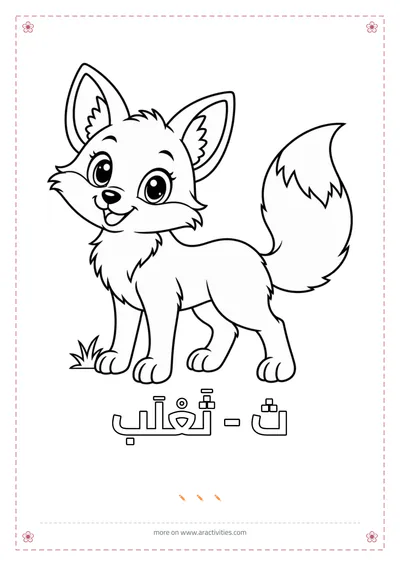
Thaa — Fox
Count the three dots, say the first sound clearly and find Thaa at the beginning of “thaʿlab.”
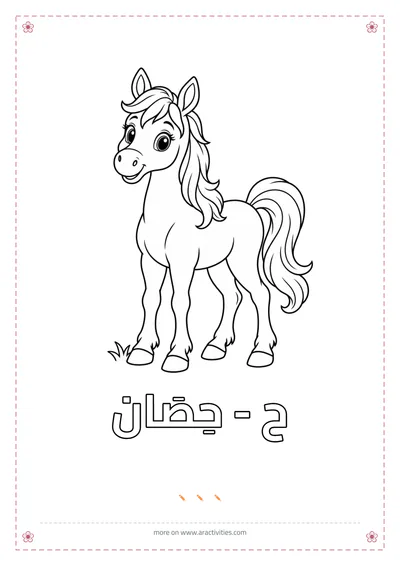
Ḥaa — Horse
Notice that Ḥaa has no dot, repeat “ḥiṣān,” and match the large letter to the word below.
Make a letter detective game: cover the animal names and show only the large letters. Ask, “Which one has three dots?” and “Which one has no dot?” Then reveal the words and say them together.
3. Khaa With Sheep and Zay With Giraffe
The final free pair adds خَرُوف (kharūf, sheep), beginning with خ, and زَرَافَة (zarāfah, giraffe), beginning with ز. These words are excellent for listening practice because their first sounds are distinct.
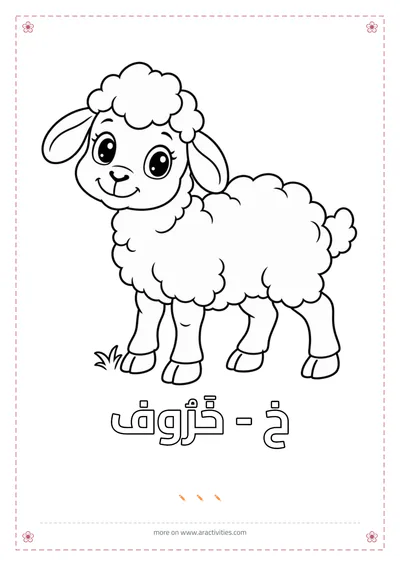
Khaa — Sheep
Find the dot above Khaa, say “kharūf,” and listen for the deeper first sound.
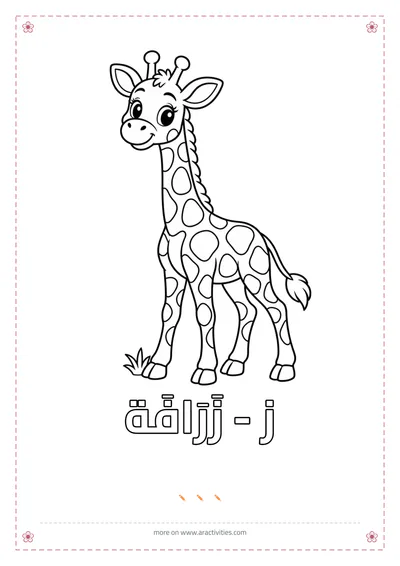
Zay — Giraffe
Point to the dot above Zay, stretch the first sound in “zarāfah,” and say the whole word.
Check recall later: after putting the crayons away, name one animal in English and ask for the Arabic word. If the child needs help, show the picture first, then the beginning letter. Try again the next day before introducing another page.
A Simple 10-Minute Arabic Coloring Routine
- Look and predict. Ask what animal the child sees and whether they already know its Arabic name.
- Listen and repeat. Say the Arabic word naturally two or three times, then let the child repeat without pressure.
- Find the first letter. Point to the large letter and match it to the first character in the animal name.
- Color and talk. Use the word naturally while coloring: “The asad has a big mane.”
- Recall without looking. Cover the label and ask for the word or beginning letter. Give a clue if needed.
Keep sessions short and end while the child is still engaged. One or two pages are enough at a time. Revisit finished pages on a wall, in a binder or as homemade flashcards so that the vocabulary returns across several days instead of disappearing after one coloring session.
Continue Through All 28 Arabic Letters
Enjoyed these six samples? The complete Arabic Alphabet Animal Vocabulary set includes 28 activity pages—one for every Arabic letter—with a colorable letter, Arabic animal name and child-friendly illustration. Download one printable PDF plus all 28 individual PNG pages.
Get the Complete 28-Page Set →Printing and Classroom Ideas
Each free page downloads as a full-resolution PNG. Open it, choose portrait orientation and select Fit to page or Scale to fit. Use regular printer paper for crayons or colored pencils and heavier paper for markers. The pages work well for letter-of-the-week lessons, Arabic vocabulary centers, morning work, quiet practice, early finishers and take-home review.
Frequently Asked Questions
Are all six Arabic animal coloring pages free?
Yes. Download each full-resolution PNG directly from this page without creating an account or entering an email address.
What ages are these pages best for?
They are designed mainly for ages 4–8, but any beginner can use them to practise Arabic letter recognition and animal vocabulary.
Should my child color all six pages at once?
No. One or two pages per session keeps the language focus clear. Briefly revisit earlier words before adding a new pair.
Does the complete set cover every Arabic letter?
Yes. The complete product contains 28 pages, one animal vocabulary activity for every Arabic letter, supplied as one printable PDF and 28 individual PNG files.
Can I print the free pages for my students?
Yes. Parents, homeschoolers and educators may print them for their own children or students. Please do not sell or redistribute the digital files.
Explore more free Arabic activities
Continue learning with interactive Arabic letters, sounds, animals, vocabulary games and printable worksheets.
Browse Arabic Activities →