Teaching Arabic numbers for kids has two parts: the number words (وَاحِد، اثْنَان، ثَلَاثَة) and the written digits. Many families are surprised to learn that the digits we call "Arabic numerals" in English (0 1 2 3) are not the ones most Arabic books print, which use ٠ ١ ٢ ٣ instead. Learning both is easier than it sounds, and it opens the door to maths, Quran reading and everyday Arabic literacy.
This guide explains the difference between the two sets of digits, shows how to count from 1 to 100 in Arabic, suggests what to teach at each age and gives six easy counting games. The number words below are in Modern Standard Arabic. Spoken dialects differ, so ask a native speaker if you want the local version.
Transparency note: we build free learning games at Aractivities and link to one of them below. Every activity here works with paper, dice and objects from around the house.
Eastern vs Western Arabic numerals
Our number system, with place value and zero, began in India. Arabic-speaking scholars adopted it and helped spread it, and the digit shapes then developed differently in different regions. According to Wikipedia's overview of Arabic numerals, the forms we use today in Europe and the Americas reached Europe around the 10th century through Arabic speakers in Spain and North Africa.
Western Arabic numerals (0 1 2 3 4 5 6 7 8 9) are the standard digits in Europe and the Americas, and they are the ones used in the Maghreb (Morocco, Algeria and Tunisia).
Eastern Arabic numerals (٠ ١ ٢ ٣ ٤ ٥ ٦ ٧ ٨ ٩) are used with Arabic script in much of the Middle East. Arabic speakers often call them Hindi numerals (الأرقام الهندية) because of their Indian origin. In practice, both sets are used side by side in many Arabic-speaking countries, and the Western digits are increasingly common on phones and websites.
The maths is identical in both: base 10, place value and zero work the same way. Only the symbols change. That is a helpful idea for children, because it shows that a number is separate from the symbol that represents it.
The 10 digits at a glance
Here are the Eastern digits next to their Western versions, the Arabic number words and a memory tip for each. Say the word aloud together as you point to the digit.
| Eastern | Western | Arabic word | Say it | Memory tip |
|---|---|---|---|---|
| ٠ | 0 | صِفْر | sifr | A dot for "nothing" |
| ١ | 1 | وَاحِد | wāḥid | One straight stick |
| ٢ | 2 | اثْنَان | ithnān | Two of everything: eyes, hands |
| ٣ | 3 | ثَلَاثَة | thalāthah | Count three toys |
| ٤ | 4 | أَرْبَعَة | arbaʿah | Four rakʿat in Dhuhr |
| ٥ | 5 | خَمْسَة | khamsah | A circle for five fingers; it looks like a zero! |
| ٦ | 6 | سِتَّة | sittah | Six sides on a die |
| ٧ | 7 | سَبْعَة | sabʿah | Looks like a V |
| ٨ | 8 | ثَمَانِيَة | thamāniyah | Looks like an upside-down V |
| ٩ | 9 | تِسْعَة | tisʿah | Looks much like our 9 |
| ١٠ | 10 | عَشَرَة | ʿasharah | A one and a dot |
Counting from 10 to 100
Once your child knows the first ten, counting to 100 follows patterns. The tens have their own names, and numbers in between are built from them.
| Eastern | Western | Arabic word | Say it |
|---|---|---|---|
| ١٠ | 10 | عَشَرَة | ʿasharah |
| ٢٠ | 20 | عِشْرُون | ʿishrūn |
| ٣٠ | 30 | ثَلَاثُون | thalāthūn |
| ٤٠ | 40 | أَرْبَعُون | arbaʿūn |
| ٥٠ | 50 | خَمْسُون | khamsūn |
| ٦٠ | 60 | سِتُّون | sittūn |
| ٧٠ | 70 | سَبْعُون | sabʿūn |
| ٨٠ | 80 | ثَمَانُون | thamānūn |
| ٩٠ | 90 | تِسْعُون | tisʿūn |
| ١٠٠ | 100 | مِائَة | miʾah |
Point out the pattern: from 20 to 90, the tens all end in -ūn, which you will often hear as -īn in speech. This is much like English, where the tens end in -ty.
For the numbers in between, Arabic puts the units first. Twenty-five is خَمْسَة وَعِشْرُون (khamsah wa ʿishrūn), literally "five and twenty". German and Dutch work the same way, so children who know either language will find it familiar. The teens use a unit plus ʿashar, for example aḥad ʿashar for 11 and ithnā ʿashar for 12.
How to teach Arabic numbers for kids, age by age
Ages 2–3: counting by ear
Before a child understands quantity, they can still learn the counting sequence by rote, just as they do in English. Count stairs, fingers at bath time and grapes as you put them on a plate. At this age the goal is to get used to the sounds, not to understand maths.
Ages 4–5: recognising digits
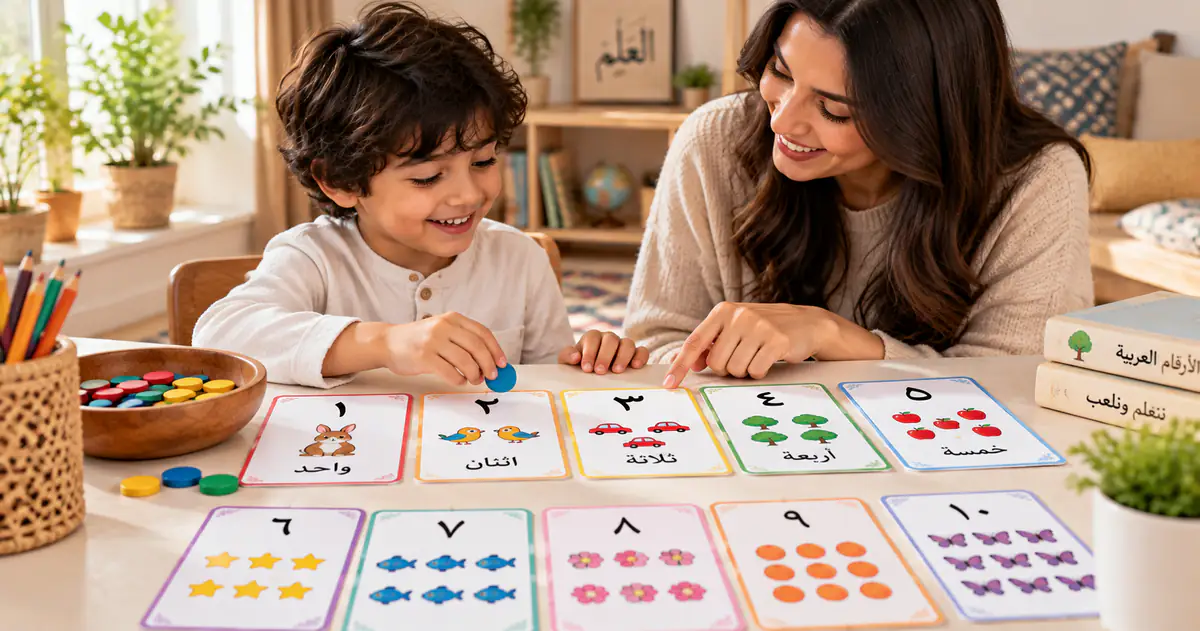
Once your child recognises Western digits 1–10, show the Eastern ones next to them on a flashcard. Keep it light: "This is how many people write the number 5: ٥!" Avoid drilling, and spend extra time on the look-alikes ٥ and ٠.
Ages 5–7: counting with meaning
Link the words to real quantities. How many apples? (kam tuffāḥah?) How many fingers? How many rakʿat in Dhuhr? (arbaʿah.) Use Arabic numbers when setting the table or sharing snacks, so numbers become useful tools.
Ages 7–10: simple sums in Arabic
Introduce short sums in Arabic: thalāthah zāʾid ithnān, kam? (three plus two, how many?). Then move on to taking away, with nāqiṣ for "minus". Reading numbers in Eastern digits on a calendar or in a book is also good practice at this age.
Six counting games to play at home
- Staircase counting. Count each step in Arabic going up and down. Once 1–10 is automatic, count only odd numbers, or count backwards.
- Grocery helper. At the shop, ask your child to find sittah apples or count how many yoghurts are in the pack. Real tasks give numbers a purpose.
- Digit hunt. Write the Eastern digits ١–٩ on cards and hide them around a room. Your child finds them and puts them in order. Add the tens for older children.
- Dice in Arabic. Roll two dice and add them in Arabic: "arbaʿah zāʾid thalāthah, sabʿah!" A weekly dice game builds counting and basic addition without any pressure.
- Pretend shop. Label toys with Eastern-digit prices. Your child "buys" items and works out the total, which combines recognising digits, saying number words and adding.
- Calendar of the month. Hang a calendar with Eastern digits and let your child mark off each day, saying the number in Arabic. A few seconds each morning is enough.
Connecting Arabic numbers to real maths
Arabic numbers should not sit in a separate box from "real" maths. Once your child can count to 20 in Arabic, use the same words for simple addition and subtraction: "You have khamsah sweets and give ithnān to your sister. How many are left? Thalāthah!"
One thing to explain early: Arabic text runs right to left, but digits are written with the largest place on the left, just like in English. So ١٢٣ is one hundred and twenty-three. If you want extra practice with times tables, our free Monster Multiplication game covers general arithmetic, though it is a maths game rather than an Arabic-numerals lesson, so keep using the paper and spoken activities above for the Arabic itself.
Common mistakes to avoid
- Teaching digits before sounds. Let children hear and say the number words first, then match them to symbols.
- Overlooking ٥ and ٠. These two look alike to Western eyes. Practise them together early.
- Mixing dialect and standard forms without telling your child. If your family speaks a dialect, say so. Children can learn both, but they need to know which is which.
- Making it a test. Quick, playful moments work better than long drilling sessions.
Frequently asked questions
What is the difference between Eastern and Western Arabic numerals?
Both sets come from the same positional number system, which began in India and was spread by Arabic-speaking scholars. Western Arabic numerals (0–9) are the digits used in Europe and the Americas, and they are the standard in the Maghreb. Eastern Arabic numerals (٠–٩) are used with Arabic script in much of the Middle East. Both are base 10 with place value, so the maths is identical and only the symbols differ.
At what age should I teach Arabic numbers?
Counting by ear can start around age 2. Many children begin recognising written numerals between ages 4 and 6. If your child already knows 1–10 in Western digits, adding the Eastern digits is a natural next step.
Should I teach Eastern Arabic numerals if my child already knows Western ones?
Usually yes, if your child is learning to read Arabic. Eastern digits appear in many Arabic books, calendars, signs and Quran editions. Western digits are also common, especially in North Africa and online, so it helps to recognise both.
Are Arabic numbers written right to left?
Arabic text runs right to left, but digits are written with the largest place on the left, exactly as in English. So ١٢٣ is one hundred and twenty-three.
Why does the Arabic five look like a zero?
In Eastern Arabic numerals, ٥ (five) looks like a small round zero, while ٠ (zero) is just a dot. It is the most common mix-up. Practise the pair together: a dot for nothing and a circle for five.
Next steps
Start with counting by ear this week: stairs, fingers and snacks. When 1–10 feels easy, add the Eastern digits on flashcards. For more on teaching Arabic numbers for kids and the language around them, these guides may help: