Teaching the 99 Names of Allah for kids works best when the names are not treated as a list to tick off. When a child hears "Al-Rahman, Al-Rahim" at every Bismillah, and later learns what those names mean, they build a lived sense of Allah's mercy long before they can explain it. That is exactly the right order.
This guide explains how to approach the names in three stages, gives an age-by-age plan, suggests six names to start with and offers simple everyday techniques. It is written for parents, not as a scholarly text, so for religious questions beyond the basics please ask a qualified teacher.
Transparency note: we build free Islamic learning games at Aractivities, so we link to one or two of them below. Everything in this guide works without them.
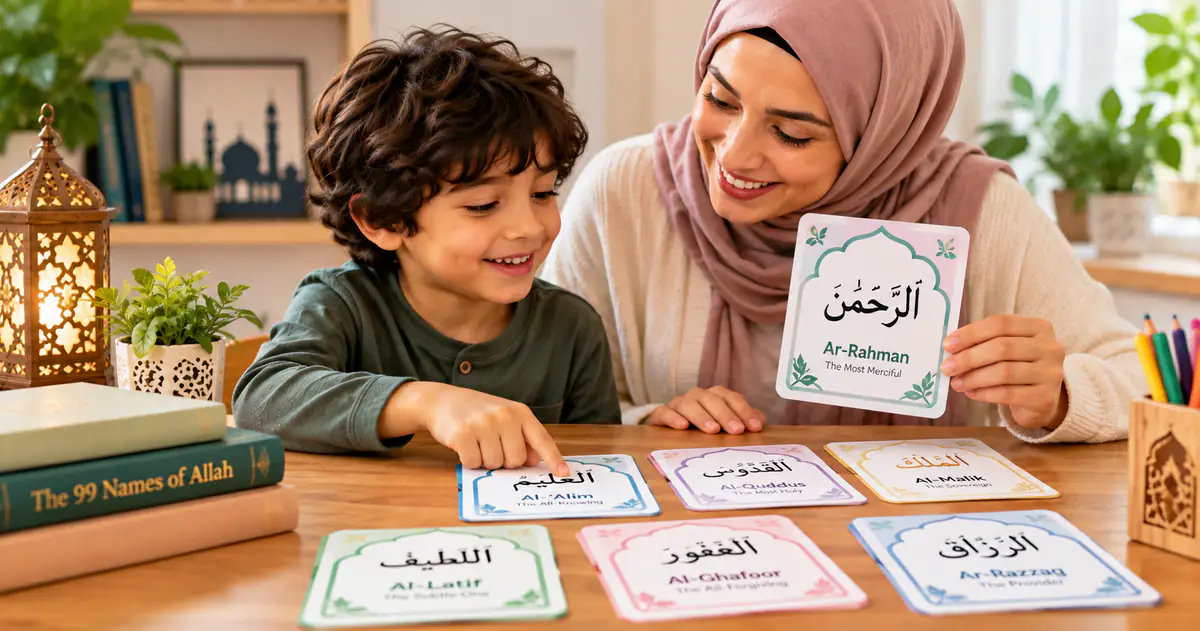
Why the Names of Allah matter beyond memorisation
The hadith about the names is recorded in Sahih al-Bukhari and Sahih Muslim: Allah has ninety-nine names, and whoever aḥṣāhā them will enter Paradise. The Arabic word أَحْصَاهَا is translated in different ways, including "knows", "counts" and "memorises". Scholars explain that it covers more than recitation. One well-known explanation on IslamQA lists learning to pronounce the names, understanding their meanings, calling upon Allah by them and living by what they imply.
That points to a better goal than reciting all 99 in order. A child who can list every name but cannot explain one has learned sounds. A child who makes a mistake, remembers Al-Tawwab (the Ever-Accepting of Repentance) and feels comforted in turning back to Allah has started a relationship with that name.
The Quran also invites us to call on Allah by His names: "To Allah belong the best names, so invoke Him by them" (7:180). That is why the approach below focuses on meaning and use, not only memory.
The three stages of learning each name
Every name can be learned at three progressively deeper levels. Knowing which stage your child is at helps you decide the next step without rushing.
- Recognition. The child knows the Arabic name and its meaning: "Al-Khaliq means the Creator." The name is stored as a fact.
- Understanding. The child understands what the name says about Allah: "Al-Khaliq means Allah created everything, from the sun and mountains to me. Nothing creates itself."
- Living the name. The child uses the name in the right moment. They see a beautiful bird and think of Al-Khaliq, or feel afraid at night and remember Al-Hafiz (the Guardian).
Most children's Islamic education stops at stage one. The aim is to move children toward stage three for the names they meet most often, not for all 99 at once.
An age-by-age approach to Asmaul Husna
What suits a four-year-old will frustrate a ten-year-old. Use the table below as a flexible guide, not a strict timetable. Every child is different.
| Age | Focus | Example |
|---|---|---|
| 3–5 | Hearing the names in daily life; no formal teaching needed | Al-Rahman and Al-Rahim in Bismillah; Al-Khaliq when looking at nature; Al-Sami' (the All-Hearing) when making du'a |
| 6–8 | Two or three names a month, each with a simple meaning and one real-life example | Al-Razzaq (the Provider): "Who gave us this food? Allah provides for every living thing." |
| 9–11 | Pairs and contrasts, and noticing shared Arabic roots | Al-Awwal and Al-Akhir (the First and the Last); Al-Zahir and Al-Batin (the Manifest and the Hidden) |
| 12+ | Deeper meanings and using names in personal du'a | Al-Razzaq when asking for provision; Al-Ghaffar or Al-Tawwab when seeking forgiveness |
Six names to start with, and why
Instead of working through the list in order, begin with names your child meets again and again. Each repeat gives you a chance to deepen the meaning. Here are six good starting points, with a child-friendly way to explain each.
Al-Rahman: The Most Merciful
Allah's all-encompassing mercy toward every creature. Every Bismillah begins with it. For children: "Allah's mercy is so big it covers everyone and everything, even the animals and the birds."
Al-Rahim: The Especially Merciful
Many scholars explain this as Allah's special, ongoing mercy toward the believers, and it is paired with Al-Rahman in Bismillah. For children: "Allah loves everyone, and He takes special care of those who love Him and try to do right."
Al-Khaliq: The Creator
Allah created everything. It comes up naturally in nature. For children: "Look at that butterfly. Allah designed every detail of its wings. Al-Khaliq means the One who creates."
Al-Alim: The All-Knowing
Allah knows everything, seen and unseen. For children: "Al-Alim means Allah knows everything, including how you feel. You never have to hide your feelings from Him."
Al-Tawwab: The Ever-Accepting of Repentance
Allah accepts sincere repentance and turns back to His servant with mercy. It supports healthy attitudes to mistakes. For children: "When you make a mistake and truly say sorry, Allah is always ready to forgive."
Al-Hafiz: The Guardian
Allah preserves and protects all that He has created. It can comfort a child who feels afraid. For children: "Al-Hafiz means Allah is always watching over you and keeping you safe."
A simple way to explain Al-Rahman and Al-Rahim together is as a picture, not a definition: Al-Rahman is like rain that falls on every garden, and Al-Rahim is like a gardener who tends each plant. This is only an analogy to help young children, so keep the Arabic names and the real meanings at the centre.
Six everyday techniques that work
Children learn the names best when they meet them in ordinary moments, not only during "Islamic study" time.
- Name of the week on the fridge. Write one name in Arabic and English on a card in the kitchen. Say it aloud each time someone passes. By the end of the week, everyone knows it.
- Connect names to daily moments. Before eating, Al-Razzaq provided this food. When it rains, Al-Wadud (the Most Loving) is sending mercy to the earth. When a child recovers from illness, Ash-Shafi (the Healer) has restored their health. Real-time links beat flashcards.
- Ask "which name fits?" After something happens, ask: "We lost it and then found it. Which name of Allah does that remind you of?" (Al-Mujib, the Responsive, is one answer.) This trains children to think, not just repeat.
- Du'a by name. Teach children to call on Allah by the name that matches what they are asking for, such as "Ya Alim, help me remember what I've learned" before a test. This follows the guidance to invoke Allah by His names.
- Slow down with calligraphy and conversation. Use one of our free Names of Allah coloring pages to focus on a single name. Say it together, share one child-friendly meaning and ask one open question while your child colors.
- Add short quiz practice. Short, low-pressure recall practice helps children remember what they learned. Research on distributed practice suggests that brief, repeated sessions work better than one long one. If you like games, our free Quran Words game offers a timed Quranic vocabulary quiz, and Islamic Quiz Battle suits children from about age 8. Flashcards or a family quiz work just as well.
A note on Arabic pronunciation
Many parents hesitate to teach the names because they are unsure of their own Arabic. Don't let that stop you. Learn alongside your child, listen to a clear recording by a reputable reciter or teacher, and ask someone you trust to check anything you are unsure about. Children usually improve quickly with regular listening, and your example of sincere effort teaches as much as the names themselves.
Common mistakes to avoid
- Rushing through all 99. A smaller number of names understood well is more valuable than the full list recited without meaning.
- Teaching only the sounds. Always pair the Arabic name with its meaning and a real example.
- Using the names to frighten. Balance Al-Alim (He knows everything) with the names of mercy and forgiveness, so that children grow up with love and hope, not only fear.
- Treating it as a test. Constant quizzing can make children avoid the topic. Let some moments be pure listening and conversation.
Frequently asked questions
How many of the 99 Names of Allah should children memorise?
There is no fixed number children must reach by a certain age. Scholars encourage learning the names, understanding their meanings and calling on Allah by them. For children, depth matters more than speed: ten names truly understood are worth more than 99 recited without meaning. If you want guidance on a specific religious question, ask a qualified teacher.
What age should children start learning the Names of Allah?
Children can hear Al-Rahman and Al-Rahim from infancy through the daily Bismillah. Around ages 3 to 5, simple names with concrete meanings, such as Al-Khaliq (the Creator), can be introduced through everyday moments. Many families begin a more structured routine from about age 6 or 7, when children can connect a name to a meaning and an example.
Should children learn the Arabic names or the English meanings first?
Learn both together from the start. The Arabic name is the authentic form, and the meaning gives it life. Say "Al-Rahman means the Most Merciful" as one unit rather than as a translation exercise. Over time the Arabic name becomes the main cue and the meaning follows naturally.
What is the difference between Al-Rahman and Al-Rahim?
Both names come from the same root, r-h-m, meaning mercy. Many scholars explain Al-Rahman as Allah's all-encompassing mercy toward all creation, and Al-Rahim as His especially merciful care for the believers. A simple picture for children: Al-Rahman is like rain that falls on every garden, and Al-Rahim is like a gardener who tends each plant.
Is the list of 99 names the same everywhere?
Not exactly. The authentic hadith states that Allah has ninety-nine names, but scholars differ slightly on which names make up the commonly taught list, and many explain that the hadith does not limit Allah's names to ninety-nine. Choose a list your local teacher or mosque recommends and use it consistently.
Next steps
Choose one name from the six above, write it on a card and use it in three ordinary moments this week. When your child is comfortable, add a second name. For more ideas on teaching the 99 Names of Allah for kids and other Islamic basics, these guides may help: